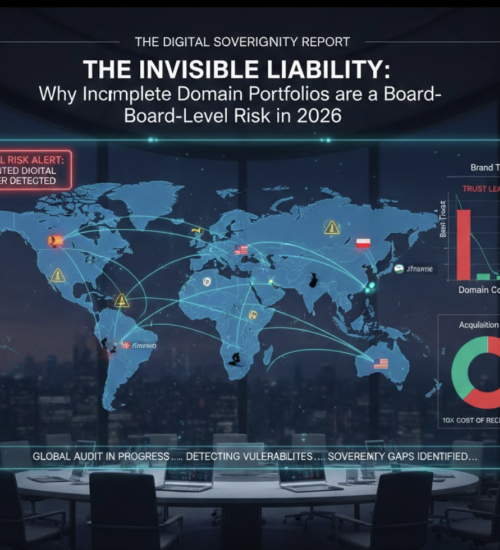
The Invisible Liability: Why Incomplete Domain Portfolios are a Board-Level Risk in 2026
1 lutego 2026

As we approach the end of 2025, the global technology sector is facing a reckoning regarding Intellectual Property (IP). The rapid expansion of startups into international markets has exposed a critical flaw in many business models: the lack of original, clean title to their foundational ideas. In the upcoming year, we expect "Bad Faith" registrations and the infringement of prior rights to become the primary reasons for failed investment rounds and stalled global expansions.
Understanding the Concept of Priority The principle of priority is the bedrock of international IP law. It is not merely about who registered a trademark first, but who can prove the original creation and documentation of a concept. Historically, many innovators have found themselves sidelined by former partners or entities that attempted to capitalize on their vision. However, international bodies like WIPO and EUIPO have signaled that 2026 will be a year of stricter enforcement. "Bad Faith"—the act of registering assets while knowing they belong to another—is becoming a permanent stain on a company's reputation and a direct threat to its valuation.
The Impact on Global Funding Venture capital firms in major hubs, particularly in the Middle East and North Europe, are shifting their due diligence focus. They are no longer satisfied with a simple trademark certificate; they are demanding proof of the "original blueprint." A company that cannot demonstrate a clear, undisputed path from the initial concept to its current state is now considered a high-risk liability. For original creators, this shift represents a long-awaited vindication. The strategic holding of key domains and historical documentation is now recognized as the ultimate proof of ownership.