Supply Chain Resilience: Navigating the New Trade Corridors between MENA and EU
8 stycznia 2026
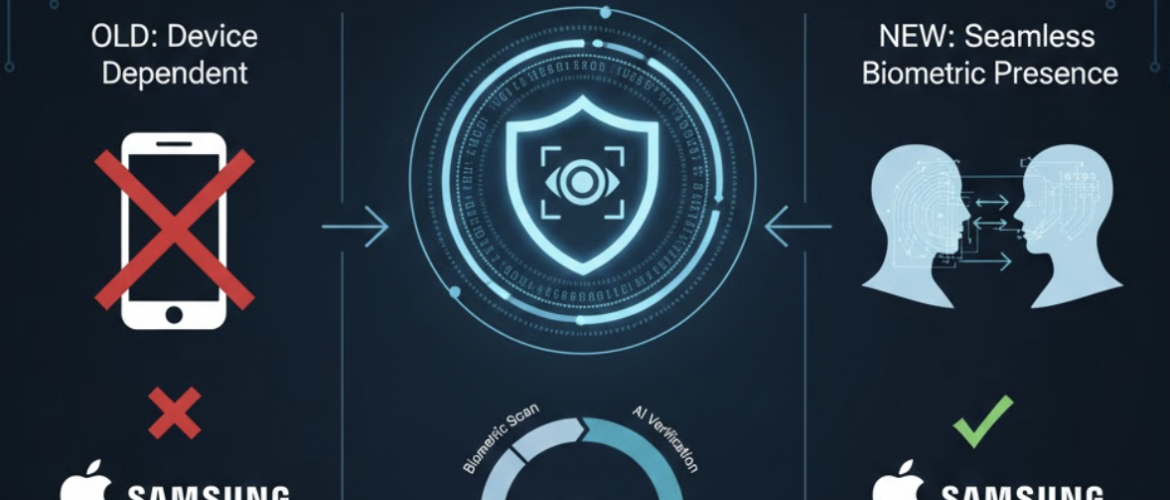
The Final Deconstruction of the Wallet In a move that many industry observers have termed the "Post-Device Declaration," Apple and Samsung have announced a historic collaborative protocol: the Universal Biometric Presence (UBP). This agreement, finalized in early 2026, marks the beginning of the end for the smartphone as a mandatory payment interface. For nearly two decades, the mobile device acted as the bridge between the human and the bank account. Today, that bridge is being dismantled. The UBP standard allows for seamless authentication where the hardware becomes secondary to the individual’s biological presence. We are entering the age of the "Zero-Wallet," where the body is not just the key, but the entire secure terminal.
The Mechanics of Ambient Authentication The shift to UBP relies on what engineers call "Ambient Biometrics." Unlike the active scanning required by early-generation FaceID or TouchID, UBP-enabled environments use a mesh of ultra-high-frequency sensors and AI-driven liveness detection to verify an individual as they move through a space.
The "Walk-Through" Experience: Imagine entering a high-end boutique or a transit hub. As you approach a terminal or a doorway, the system identifies your unique iris pattern and thermal vascular signature in real-time.
Seamless Settlement: The transaction is authorized through a decentralized biometric handshake. No phone is pulled from a pocket; no smartwatch is tapped against a reader. The infrastructure recognizes you, validates your "Proof of Personhood," and settles the transaction against your designated sovereign account.
The Crisis of Fragmented Identity As Apple and Samsung push this standard into the mainstream, a massive infrastructure gap has emerged. While the hardware giants control the sensors, they do not control the "Digital Perimeter" that gives these transactions trust and legitimacy on a global scale. This is where the battle for Biometric Sovereignty is being fought. In 2026, a brand that provides biometric services but lacks a unified, global domain presence (such as the coordinated .finance, .ai, and .io extensions) is viewed as a fragmented player. Corporations are realizing that in a "Zero-Wallet" world, your digital address is your only physical storefront. Ownership of the global perimeter is the only way to ensure that a biometric handshake in London is recognized with the same legal and technical authority in New York or Mumbai.
Conclusion: The Vanguard of the Invisible The "Zero-Wallet" standard is the ultimate realization of the Invisible Lifestyle. It represents a world where technology has finally achieved its highest form by becoming unnoticeable. For the "Business Vanguard," this represents a unique investment window. The value is no longer in the device—which is becoming a commodity—but in the underlying infrastructure of identity. Those who secured the foundational rights and the global digital perimeter during the "Conceptual Era" of 2017–2020 are now the gatekeepers of this invisible economy. In 2026, the most powerful companies are those that you cannot see, but whose presence you feel every time you walk through a door.